
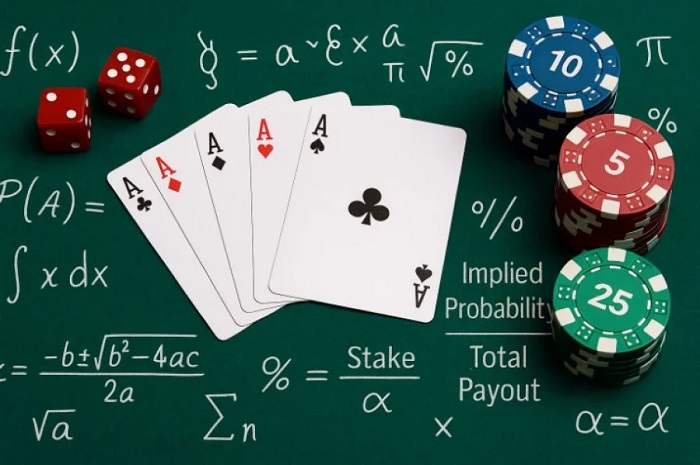
Popular culture has long romanticized poker as a duel of psychological mysticism. Films and televised tournament highlight reels love to frame the game around cinematic hero calls: an introspective player staring across the felt, identifying a microscopic facial tick in their opponent, and pushing a tower of chips into the middle based on pure instinct. It makes for compelling television, but treating intuition as the foundation of winning play is a reliable path to going broke.
Beneath the psychological maneuvering, table presence, and chips lies an unforgiving framework of applied probability. Long-term winners do not view poker as a guessing game governed by luck or spiritual momentum. Instead, they operate as disciplined risk analysts working with incomplete information. Every bet, raise, call, and fold is an exercise in applied mathematics designed to exploit structural probabilities over thousands of hands.
The Arithmetic of Outs and Pot Odds
At its most fundamental level, poker math is about comparing the cost of staying in a hand against the likelihood that the hand will improve to a winner. The cards remaining in the deck that can complete a player’s drawing combination are known as outs.
For example, a player holding four cards to a flush with one card left to come has nine outs among the remaining unseen cards. To translate those outs into a quick working probability at the table, experienced players rely on practical heuristics such as the Rule of Four and Two. By multiplying their active outs by four after the flop, or by two after the turn, a player can approximate their percentage chance of hitting their draw. Nine outs multiplied by four yields an estimated thirty-six percent chance to complete the flush with two cards to come.
Once equity is established, it must be measured against pot odds—the ratio between the size of the current pot and the amount of money required to call a bet. If an opponent bets fifty dollars into a one-hundred-dollar pot, the total pot grows to one hundred and fifty dollars. Calling requires putting in fifty dollars to contend for a two-hundred-dollar post-call pot.
The mathematical requirement to call is simple division: fifty divided by two hundred equals twenty-five percent. If the player’s draw has a thirty-six percent chance of completing, the equity exceeds the price of the ticket. Over the long run, taking this bet will generate a net profit, regardless of whether that specific flush arrives on the next river card.
Expected Value: Separating Process from Outcome
One of the greatest mental barriers for novice players is results-oriented thinking. In a single hand, an awful decision can be rewarded by a lucky river card, while a mathematically pristine decision can result in a devastating loss. This short-term discrepancy is known as variance.
Professional strategy relies entirely on the concept of Expected Value (EV). Expected value measures the average amount of money a specific decision will win or lose if that identical scenario is played out thousands of times. A move that yields a positive expected value (+EV) is mathematically sound, even if it loses money on a particular evening. Conversely, a move with a negative expected value (-EV) is a strategic error, even if the player happens to stack their opponent’s chips at the end of the round.
By focusing entirely on EV rather than immediate chip counts, winning players detach their emotions from the short-term swing of the cards. They recognize that short-term volatility is merely the friction of probability working itself out. Over an infinite horizon, luck neutralizes itself, leaving mathematical discipline as the sole determinant of profitability.
Implied Odds and the Geometry of Position
Direct pot odds capture only the immediate financial picture, but poker is rarely static. When evaluating a speculative hand, players must also calculate implied odds—the potential bets an opponent will willingly pay off on later streets once a hidden draw connects.
If a player holds a low pocket pair and is calling a pre-flop raise purely to hit three-of-a-kind, the direct pot odds are often insufficient. However, if the opponent holds an aggressive post-flop style and deep chip stacks, the implied payout on the turn and river easily justifies the initial investment.
Conversely, players must be vigilant regarding reverse implied odds. This occurs when hitting your designated card still leaves you vulnerable to a superior hand. Drawing to an eight-high flush or making a weak two-pair often results in winning small pots when an opponent has air, while losing massive pots when an opponent hits an even higher flush or straight. Understanding the hidden mathematics of future betting rounds prevents players from walking into expensive traps.
Combinatorics and Range-Based Thinking
Amateur players tend to place opponents on a single, specific hand. Sophisticated players think in terms of ranges—the full spectrum of hand combinations an opponent could reasonably hold given their position, table image, and previous actions.
To evaluate ranges accurately, players utilize combinatorics, which breaks down the 1,326 possible starting hand combinations in a standard deck:
-
Any specific unpaired hand (such as Ace-King) has sixteen possible combinations: four suited variations and twelve offsuit variations.
-
Any pocket pair (such as pocket Queens) has six unique combinations.
-
Flop textures immediately reduce the number of possible holding combinations an opponent can possess through the principle of card removal.
This mathematical framework enables the strategic use of blockers. If a player holds the Ace of spades on a board containing three spades, they hold the ultimate blocker: it is physically impossible for the opponent to hold the nut flush. Even if the player holds nothing else of value, possessing that card removes significant strength from the opponent’s range, providing a mathematically sound opportunity to run a high-pressure bluff.
Minimum Defense Frequency and Game Theory Optimal Play
The modern landscape of poker has been permanently altered by solver technology and Game Theory Optimal (GTO) principles. GTO focuses on building an unexploitable equilibrium strategy where an opponent cannot profit, even if they know your general approach.
A central pillar of this modern framework is the Minimum Defense Frequency (MDF). MDF calculates the exact percentage of your range that you must continue with (via calling or raising) to prevent an opponent from profitably bluffing with any random two cards. The formula is expressed through bet sizing: the pot size divided by the pot size plus the bet. If an opponent bets half the pot, the defending player must mathematically defend at least sixty-seven percent of their range to keep the bettor honest.
While pure GTO provides a baseline that prevents exploitation, the highest level of poker strategy involves exploitative play. Once a player understands the mathematically balanced baseline, they can observe when opponents deviate from it. If an amateur folds eighty percent of their hands facing a river bet—well above the mathematically required threshold—the correct response is not to remain balanced, but to relentlessly bluff that opponent off the table.
The Transformation from Gambler to Strategist
Viewing poker through an analytical lens strips away the chaotic illusion of luck. Mathematics does not guarantee a victory on any given night; the distribution of cards will always produce unpredictable swings that test an individual’s patience and emotional endurance.
What mathematics does provide is clarity. It replaces anxiety with calculated probabilities, transforms impulsive guesses into structured decisions, and equips players with a durable edge that compounds over time. In a game characterized by deception and incomplete information, probability is the only constant anchor available.
